
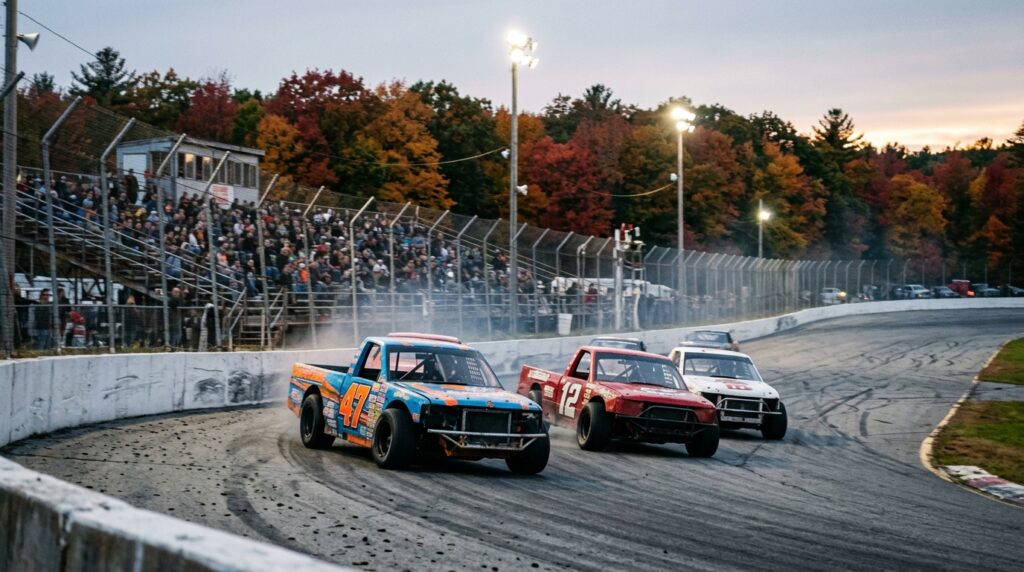
Fall short-track truck racing in New England presents challenges that drivers and crews cannot afford to ignore. As temperatures begin to drop across Connecticut, Massachusetts, Rhode Island, and neighboring states, racing teams must pay closer attention to tire performance, track conditions, mechanical preparation, and handling changes. A truck that performed well during a warm summer race may behave differently on a cool autumn evening.
For competitors at tracks such as New London-Waterford Speedbowl, the difference between an average run and a competitive feature can come down to small decisions. Tire pressures, suspension balance, braking consistency, and throttle control all influence how a truck performs as conditions change.
Autumn racing also creates unpredictable circumstances. A sunny afternoon can turn into a chilly evening, and pavement temperatures can change considerably between practice and the main event. Teams that record conditions and adjust carefully are often better prepared than those relying on a setup that worked several weeks earlier.
This guide explores how fall weather can affect truck racing, what drivers should monitor, and why preparation matters more than chasing one perfect adjustment. Whether you are an experienced regional competitor or a newcomer learning about the sport, these principles can help explain how short-track teams approach changing conditions.
For a broader introduction to local racing, visit our Waterford Speedbowl fan guide, which explains racing lines, restarts, and the atmosphere surrounding New England truck competition.
How Cooler Fall Weather Changes Short-Track Truck Performance
Temperature affects nearly every part of a racing vehicle. Tires respond differently as their operating temperature changes, engines may experience different cooling demands, and drivers encounter varying levels of grip throughout a race.
However, cooler weather does not automatically mean less traction. Track grip depends on the interaction between pavement temperature, tire construction, compound, surface condition, and the heat generated while driving. Some combinations work well in cooler conditions, while others take longer to reach their operating range.
This is why teams should avoid assuming that every autumn race requires the same adjustment. Observing actual track conditions is more reliable than applying a general rule based only on air temperature.
Why tire temperature and pressure deserve attention
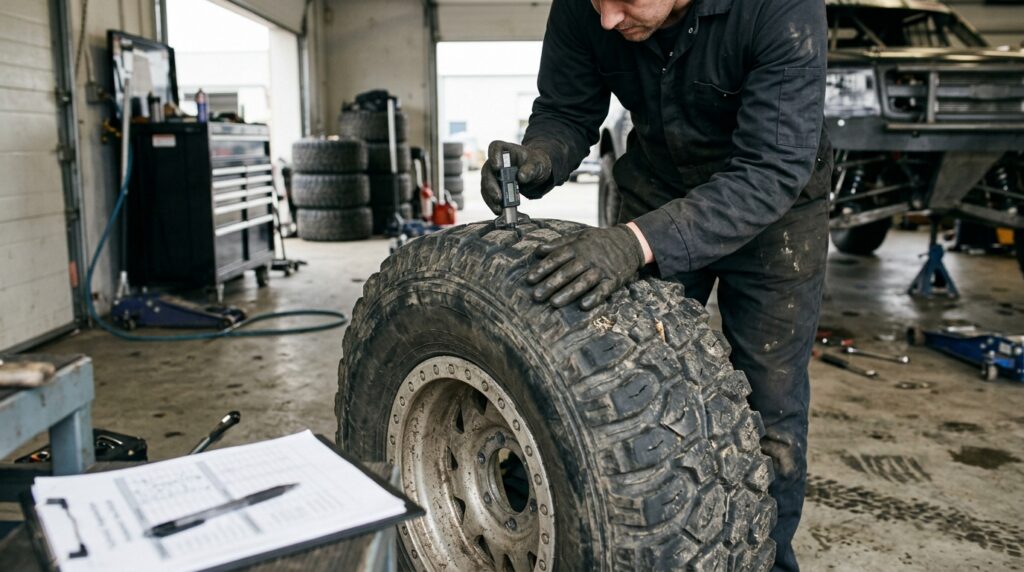
Tires are the only components that normally maintain direct contact between the truck and racing surface. Their behavior influences braking, cornering, acceleration, and stability. When temperatures change, pressure readings and the rate at which tires generate heat can also change.
A team may notice that a truck feels different during the opening laps compared with the middle of a run. The tires might need additional time to reach an effective operating temperature. Alternatively, a particular setup may generate excessive heat and reduce consistency later in the race.
The correct approach is to work within the current tire supplier’s recommendations and the series rulebook. Teams should not make extreme pressure changes without understanding the consequences, because excessive or insufficient inflation can affect safety and performance.
Cold tires can change early-lap handling
During the opening laps, a driver may experience less predictable steering or rear traction while the tires approach their operating range. The exact behavior depends on the tire specification and track conditions.
Drivers should avoid treating the first corner like a qualifying attempt when conditions are uncertain. Smooth steering inputs, controlled braking, and progressive throttle application can help them evaluate available grip without placing unnecessary stress on the vehicle.
Crews can compare driver feedback with approved tire measurements and observations from earlier sessions. This creates a clearer picture of whether the truck is improving as the run develops.
Track temperature can change throughout the event
Autumn racing often begins under different conditions from those experienced during the feature. The afternoon sun may warm the pavement, but temperatures can decline after sunset.
The track surface may also change as other divisions compete. Rubber accumulation, debris, moisture, and cleaning procedures can influence the available racing line.
Teams should record track and weather observations whenever practical. A notebook containing air temperature, track temperature where measurable, run length, tire notes, and driver feedback may reveal patterns over several events.
Rather than chasing one setup for every situation, teams can build a history of adjustments that worked under comparable conditions.
Suspension balance, braking, and corner exit
Handling is particularly important at a short oval because the truck repeatedly transitions between braking, turning, and acceleration. A small weakness that occurs in every corner can become a major disadvantage over an entire feature.
Drivers commonly describe two broad handling conditions: a truck that does not rotate enough through the corner and a truck that rotates too easily. These tendencies are often called tight and loose handling.
A tight truck may require additional steering input and resist turning toward the inside of the corner. A loose truck may feel unstable at the rear, especially when the driver applies power.
Both conditions can change during a race as tires heat up and the track evolves. The goal is not to eliminate every handling movement. Instead, the team wants a predictable truck that allows the driver to repeat competitive laps.
Why predictable handling beats a single fast lap
A qualifying setup can emphasize immediate speed, but a feature race rewards consistency. A truck that runs one spectacular lap and then becomes difficult to control may lose positions during a longer green-flag run.
Drivers should explain whether handling issues occur on corner entry, at the center, or during acceleration off the corner. These distinctions matter because the underlying causes may differ.
Crews can use those observations to evaluate mechanical setup, alignment, brake balance, and other adjustments permitted by their division.
Changes should be deliberate and documented. Altering several major settings simultaneously makes it difficult to determine which adjustment actually improved performance.
Preparing a New England Truck Racing Team for Autumn Race Nights
A successful fall race begins well before the truck reaches the speedway. Seasonal preparation should include mechanical inspections, safety checks, equipment organization, weather planning, and clear communication among crew members.
Late-season teams often face accumulated wear from previous races. Components that were reliable early in the year may require inspection after repeated heat cycles, vibration, and racing contact.
Brake components, wheel bearings, suspension connections, steering systems, and electrical wiring should be examined according to the manufacturer’s recommendations and applicable competition rules. A small mechanical problem found in the garage is usually easier to manage than the same problem discovered during a feature.
Teams must also prepare for colder pit conditions. Adequate lighting, dry equipment, appropriate clothing, and an organized workspace can reduce mistakes during busy race nights.
Building a repeatable pre-race inspection routine
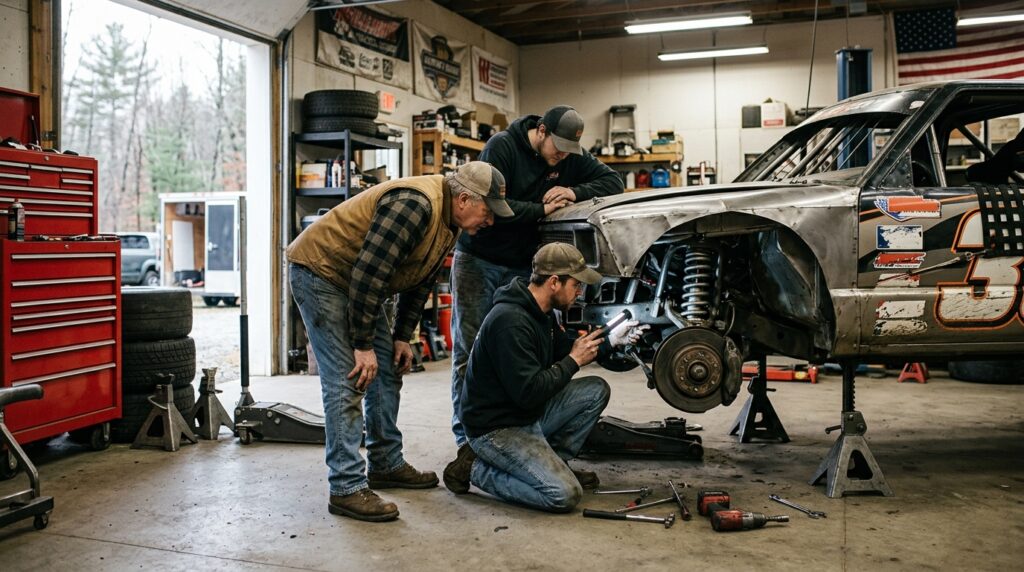
Consistency is valuable in the garage as well as on the track. Crews should use a documented inspection process instead of depending entirely on memory.
The process can cover safety equipment, mechanical fasteners, fluid levels, braking systems, steering movement, tire condition, and the condition of the truck after transportation. The exact checklist must follow the series’ technical and safety requirements.
Drivers should also inspect personal safety equipment. Helmets, head-and-neck restraints, belts, suits, gloves, and shoes must meet the standards accepted by the sanctioning organization.
For general background on motorsport helmet certification, the Snell Memorial Foundation provides information about helmet testing and certification. Competitors still need to confirm which standards their particular track or series accepts.
Driver feedback makes setup changes more effective
One of the most useful tools in regional racing is a clear conversation between the driver and crew chief. A driver who says only that the truck is difficult to drive provides limited information.
More detailed observations can identify whether the truck loses grip under braking, turns poorly in the middle of the corner, or becomes unstable on acceleration. Drivers can also report whether those problems become better or worse as the run progresses.
Teams can compare these observations against previous race notes. This helps distinguish genuine handling patterns from one unusual lap or an isolated mistake.
New drivers should develop this communication skill early. Our guide to starting truck racing in New England explains why preparation, discipline, and learning from experienced teams are essential.
Late-season races also reward patience. Drivers may need time to understand changing conditions rather than immediately forcing the truck beyond its comfortable operating range.
The September 2026 truck feature at Waterford offers a useful example of why strong race execution matters. Ryan Lineham won after starting sixth, demonstrating that the starting position is not the only factor determining a result. Read our Ryan Lineham Waterford victory analysis for a closer look at regional competition.
Although every team has different resources, reliable preparation remains accessible. A well-maintained truck, clear setup records, experienced communication, and realistic objectives can provide a strong foundation.
different resources
Small-budget teams should prioritize safety and repeatability before experimenting with costly modifications. Consistent inspections and useful driving feedback often provide more lasting value than buying parts without a clear diagnosis.
Fans benefit from understanding these technical details as well. When watching a race, notice which competitors improve during longer runs and which drivers struggle after restarts. Look for changes in racing lines and observe how teams respond when conditions evolve.
These observations reveal why truck racing involves much more than engine power. It combines mechanical knowledge, tire management, driving technique, and teamwork.
As the 2026 New England racing season moves through autumn, changing weather makes adaptability a valuable competitive advantage. Drivers who respect the conditions and crews who prepare carefully are better positioned to perform consistently.
Fall short-track truck racing is ultimately a test of preparation as much as speed. The strongest teams evaluate real conditions, follow the rulebook, preserve their equipment, and learn from every session. That approach can turn an unpredictable autumn race night into an opportunity for meaningful progress.