
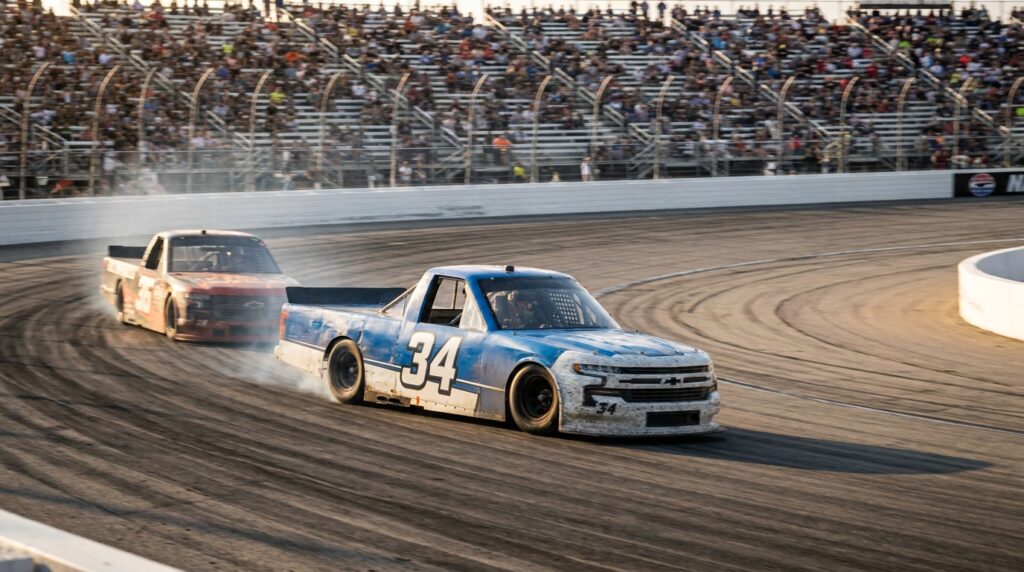
New Hampshire Motor Speedway was supposed to settle the 2026 NASCAR Craftsman Truck Series regular season. Instead, the Magic Mile delivered one of its most dramatic finishes of the year. Layne Riggs survived two overtime restarts on August 22, 2026, to win the Team EJP 175, secure his sixth victory of the season, and enter the seven-race Chase as the championship’s No. 1 seed.
Riggs started from the pole in the No. 34 Front Row Motorsports Ford and led a race-high 106 of the eventual 189 laps. The event had originally been scheduled for 175 laps, but late cautions stretched the race into double overtime. When the final restart was complete, Riggs crossed the finish line just 0.293 seconds ahead of Front Row Motorsports teammate Chandler Smith.
Kaden Honeycutt finished third, Stewart Friesen placed fourth, and NASCAR Cup Series regular Connor Zilisch completed the top five. But the finishing order tells only part of the story. New Hampshire also decided the final positions in the 2026 Truck Series Chase, turning a race in Loudon into one of the most important championship events of the year.
For New England truck racing fans, that combination of national championship pressure, short-track-style racecraft, late restarts, and regional atmosphere made the event particularly meaningful. Our earlier article on why the 2026 NASCAR Truck Series finale at New Hampshire matters to New England fans explained why the race had the potential to become a major moment for the region. The actual event delivered on that promise.
How Layne Riggs Took Control of the New Hampshire Finale
Riggs entered New Hampshire as one of the strongest drivers of the 2026 season, and his performance at Loudon reinforced that position. Although he did not control every portion of the race, the No. 34 became the truck to beat when the result mattered most.
Connor Zilisch showed considerable speed early and swept the first two stages. Riggs finished second and third in those stages, keeping himself near the front while collecting valuable points. As the race moved deeper into its final segment, however, Riggs took control and led the final 71 laps through multiple late-race disruptions.
Riggs Had to Survive More Than Raw Speed
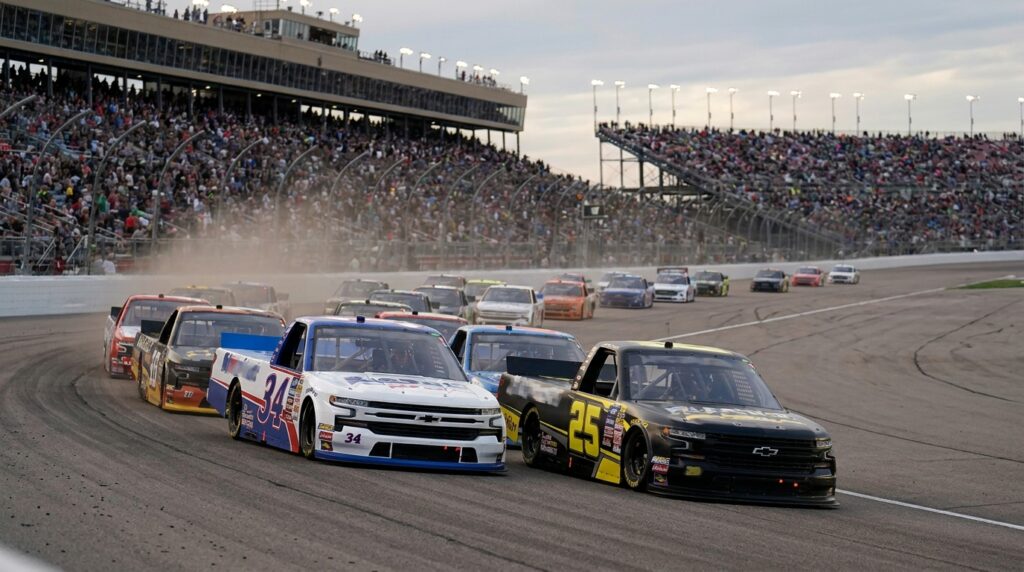
A dominant truck does not automatically produce a victory at New Hampshire. The 1.058-mile oval demands braking stability, rotation through long corners, strong drive off the turns, and discipline when traffic becomes compressed. The closing laps added another challenge: restarts.
Late cautions repeatedly erased whatever advantage Riggs had established. Instead of managing a comfortable gap, he had to defend the lead with the field packed behind him. Every restart presented another opportunity for Smith, Honeycutt, Friesen, and the other contenders to attack.
Double Overtime Turned the Finale Into a Short-Track Fight
Gavan Boschele’s late crash helped send the race beyond its scheduled distance. Additional chaos created a second overtime attempt, increasing the total distance from 175 scheduled laps to 189 completed laps.
For fans accustomed to New England short-track racing, the closing sequence probably felt familiar. A late caution changes everything. The leader loses the cushion built during the previous run. Tires cool, competitors line up side by side, and the race can suddenly be decided by one launch, one corner entry, or one mistake.
Riggs handled that pressure successfully. He kept the No. 34 in front through the final restarts and held off Smith to complete the win. The margin of 0.293 seconds demonstrates how little room separated a statement victory from a very different ending.
Leading 106 Laps Showed This Was More Than a Lucky Finish
Overtime sometimes creates surprise winners, but Riggs did not simply appear at the front because of late-race circumstances. He led 106 of 189 laps, the most of any driver in the event, and controlled the final 71 laps despite repeated interruptions.
That distinction matters when evaluating the championship picture. Winning because strategy and caution timing fall perfectly is one thing. Combining speed, track position, execution, and restart performance over the majority of a race is something else. Riggs demonstrated the kind of complete performance that explains why he finished the regular season as the top Chase seed.
The victory was also his 11th career NASCAR Craftsman Truck Series win. More importantly for the immediate championship fight, it was his series-leading sixth victory of 2026 and provided one final statement before the Truck Series takes a break and begins The Chase at Bristol Motor Speedway on September 17.
The Final Chase Spot Created Drama Behind the Winner
While Riggs and Smith fought for the trophy, another important race was unfolding farther down the order. Tyler Ankrum entered New Hampshire fighting to remain inside the championship field, and brake problems complicated his afternoon.
Ankrum eventually finished 16th, a result that would normally attract far less attention than the top-five finishers. On this particular afternoon, however, 16th was enough. He secured the 10th and final Chase position and kept his championship hopes alive.
Stewart Friesen did almost everything he could at the finish. His fourth-place result was considerably better than Ankrum’s 16th, but the full regular-season points picture mattered more than one finishing order. Friesen missed the Chase by seven points. Jake Garcia finished 14th and ended the regular season 11 points outside the championship field.
Ankrum, Friesen and Garcia Proved Every Regular-Season Point Matters
The difference between advancing and missing The Chase illustrates why stage points, consistent finishes, avoiding penalties, and limiting damage on difficult days matter across an entire NASCAR season. Friesen could finish fourth in the finale and still miss the championship field because the standings reflected the previous 17 races as well.
That concept translates directly to regional motorsports. Local championships are rarely decided by one spectacular night. Drivers build a title campaign through weeks of finishes, mechanical reliability, qualifying performance, and avoiding unnecessary mistakes. A single position gained early in the summer may eventually become the point that determines a championship months later.
Your existing article on how Richmond and New Hampshire would decide the 2026 Truck championship field highlighted exactly this type of pressure before the finale. New Hampshire provided the answer: Ankrum advanced, while Friesen and Garcia were left just outside the 10-driver Chase.
Why the New Hampshire Result Matters to New England Truck Racing
The Team EJP 175 was a national NASCAR race, but the location gives it additional importance for New England motorsports. New Hampshire Motor Speedway is the region’s biggest NASCAR stage, and hosting the Truck Series regular-season finale placed Loudon directly at the center of the national championship conversation.
That visibility matters because truck racing already has a natural connection to New England’s grassroots motorsports culture. Regional fans understand the importance of restarts, mechanical setup, braking, tire management, and fighting for position on relatively flat tracks. The scale may be different between NASCAR and a local Saturday-night series, but many of the underlying challenges are recognizable.
The Magic Mile Can Send National Fans Toward Local Racing
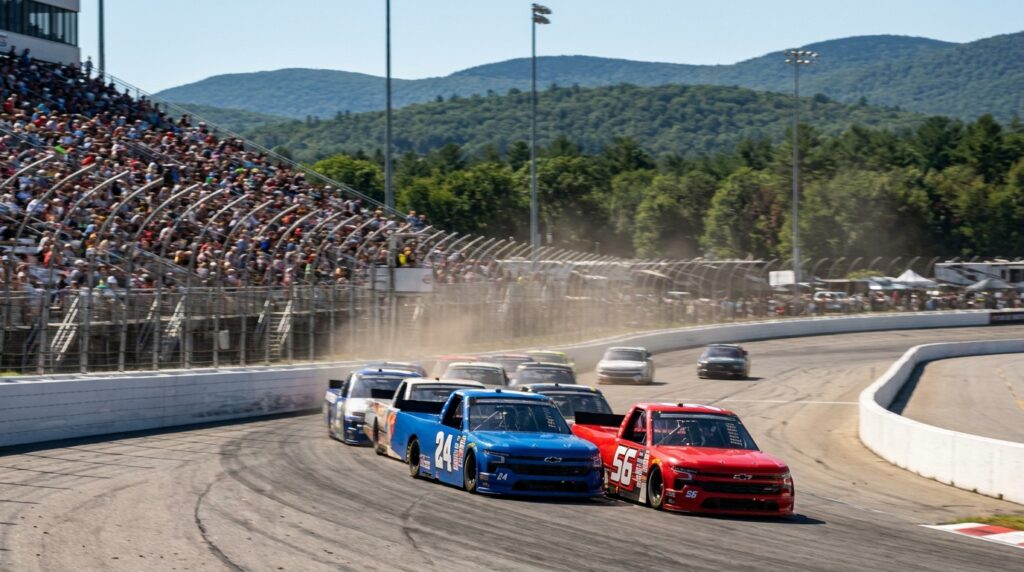
A fan who watches NASCAR trucks at New Hampshire may begin searching for other truck racing events in the region. That creates an opportunity for local tracks and series. National competition can introduce the category, while grassroots racing can give fans a closer view of the trucks, drivers, crews, and mechanical work that make the sport possible.
The August 22 weekend made that connection especially clear because NASCAR Craftsman Truck Series competition shared Saturday with the NASCAR Whelen Modified Tour. Our guide to the NASCAR Trucks and Whelen Modifieds doubleheader at Loudon examined how the combination put both national truck racing and one of New England’s strongest racing traditions on the same stage.
National Truck Momentum Can Strengthen the Regional Scene
New England short-track racing does not need to imitate NASCAR to benefit from NASCAR’s momentum. What it needs is visibility. When national truck events generate exciting finishes, manufacturer interest, recognizable drivers, and championship drama, more fans have a reason to pay attention to pickup-based racing.
Regional series can convert that attention into something more lasting by giving new fans accessible events, recognizable local drivers, strong digital coverage, and compelling stories throughout the season. Our article on how the 2026 truck racing boom can grow New England short-track racing explains why national momentum can become an opportunity for local tracks, teams, racers, and sponsors.
The official NASCAR New Hampshire Truck Series race recap confirms Riggs’ double-overtime victory, his 106 laps led, the 0.293-second winning margin over Smith, and the championship consequences of the regular-season finale.
New Hampshire to The Chase
Now the focus moves from New Hampshire to The Chase. Riggs begins the seven-race championship run as the top seed, with Honeycutt, Smith, Christian Eckes, Gio Ruggiero, Ty Majeski, Grant Enfinger, Daniel Hemric, Ben Rhodes, and Ankrum joining him in the title fight.
But whatever happens during the Chase, Loudon has already earned an important place in the story of the 2026 Truck Series season. The Magic Mile hosted a pole winner who backed up his speed by leading more than half the race, a double-overtime finish between teammates, and a championship cutoff decided by only a handful of points.
For New England racing, that is exactly the kind of event that can create new fans. It showed national truck racing at its most intense while highlighting many of the same qualities that make regional short-track competition worth following: close racing, changing strategy, late restarts, mechanical challenges, and drivers fighting for every position until the checkered flag.