

The 2026 NASCAR Truck Series championship is heading toward a finish that offers more than a typical winner-take-all showdown. On Friday, November 6, Kaden Honeycutt and Layne Riggs will take their final shots at the title at Homestead-Miami Speedway. After 24 points-paying races, Honeycutt leads Riggs by 20 points. NASCAR’s November 2 entry list confirms that these are the only two drivers still mathematically in the championship fight.
That makes the finale compelling for New England racing fans. Riggs won the August regular-season finale at New Hampshire Motor Speedway, while Honeycutt’s No. 11 TRICON Garage Toyota is led by Connecticut native crew chief Scott Zipadelli. Both teams have delivered major moments during the seven-race Chase, and both arrive in South Florida knowing that every stage, restart, and pit stop can change the outcome.
This is a pre-race guide based on official information available on November 4, 2026, in the United States. It explains the points system, what each driver must do, and why fans of local truck racing should follow the national finale closely. For the entry list and start time, consult NASCAR’s official Homestead race preview.
Why the 2026 Championship Comes Down to Two Drivers
NASCAR returned to a points-based Chase format in 2026. The Truck Series selected its top 10 drivers after the regular season, reset their points once, and began a seven-race title run. Unlike the prior elimination-based playoff, competitors are not automatically removed after predetermined rounds. Instead, the eligible driver with the highest total after the last event wins the championship. A race victory is worth 55 points, with stage points and other scoring opportunities also influencing the standings.
That context matters because the distinction between winning the race and winning the title is real. A contender can take the checkered flag but still fall short on overall points if a rival collects enough points earlier in the night. The full explanation is available in NASCAR’s 2026 Chase format guide. It is useful reading for fans accustomed to the older championship rules.
Kaden Honeycutt Enters Homestead With the Advantage

Honeycutt is the points leader after a strong Chase in the No. 11 Toyota. NASCAR’s official clinching analysis says he finished eighth or better in five of the first six postseason races and scored two Chase wins. His poorest Chase result came at Martinsville on October 30, when late contact dropped him to 14th. Even after that setback, he carries a 20-point cushion into the final night.
For a points leader, the biggest temptation is to protect the gap too cautiously. Honeycutt cannot simply assume that a respectable finish will be enough, particularly if Riggs dominates the stages and wins the race. Good qualification, clean opening laps, and efficient pit service are important because they create ways to score without relying on dramatic passes late in the feature.
How Many Points Does Honeycutt Need?
According to NASCAR’s November 3 clinching scenarios, Honeycutt guarantees the title with 55 points earned at Homestead, regardless of other drivers’ results. His position is also helped by certain tiebreaker scenarios if he finishes inside the top three. These are mathematical conditions, not a prediction about where he will finish. The practical takeaway is that stage performance and final position both matter; a comfortable-looking gap can disappear during one difficult run.
Fans can also read our earlier analysis of Honeycutt’s Kansas Chase victory to understand how he built championship momentum before Martinsville.
Layne Riggs Has a Clear Reason to Attack
Riggs built his case through pace and resilience. In August, he won at Loudon after two overtime restarts, taking the regular-season finale with 106 laps led. That performance helped him enter the Chase as its top seed. The postseason was not smooth: trouble at Bristol and contact with the wall at Kansas cost him ground. More recently, however, the No. 34 Front Row Motorsports Ford has rebounded with a Charlotte win and several consecutive strong results.
Martinsville demonstrated both Riggs’ speed and the challenge ahead. He led 156 of 200 laps, captured both stages, and finished third after Chandler Smith passed him on the late restart. Honeycutt finished 14th, leaving Riggs 20 points behind rather than completely out of reach. Our New Hampshire victory recap provides the regional backstory behind his run.
Can Riggs Win the Race but Lose the Championship?
Yes. A win is enormously valuable under the 2026 format, but the title depends on total points. NASCAR states that Riggs guarantees the championship with 75 points at Homestead, while also noting specific tiebreaker combinations involving Honeycutt. Rather than assume one dramatic pass settles everything, fans should track each driver’s stage points and the live championship standings. A difference established before the final stage could determine how aggressively either team races the closing laps.
Riggs also carries a meaningful New England connection. He proved at New Hampshire that a driver can control much of a race and still face extreme pressure from a restart. Homestead is a different kind of venue, but staying composed when the title is at stake remains essential. Aggression may be necessary; needless contact or a pit-road mistake would be especially costly.
What New England Fans Should Watch on Championship Night
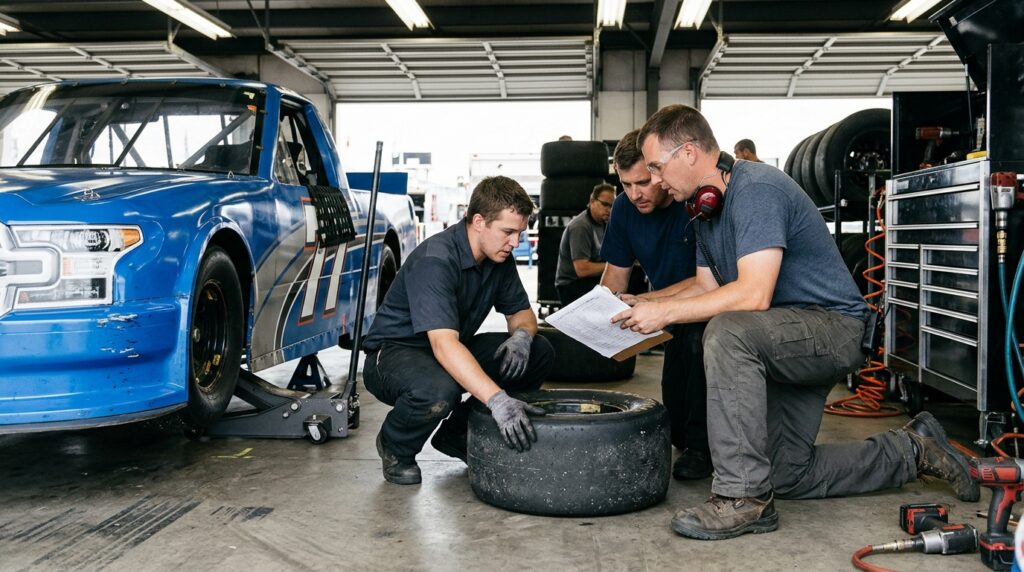
The championship race is scheduled for Friday, November 6, 2026, at 7:30 p.m. Eastern. NASCAR lists FS1, FOX One, NASCAR Racing Network Radio, and SiriusXM NASCAR Radio among the coverage options. The official entry list contains 35 trucks, so contenders will be racing competitors with their own goals, not simply each other. A non-title driver can win the event, influence a restart, or force a difficult lane choice.
That is part of what makes this championship relatable to fans at the New London-Waterford Speedbowl. Local features and national events differ in scale, but drivers still need to manage tires, communicate clearly with crews, and find a workable line through traffic. Our Waterford truck racing fan guide explains several of those fundamentals from a short-track spectator’s perspective.
Stages, Tire Management, and Pit Decisions Could Swing the Title
Homestead rewards drivers who can adjust to changing grip and changing traffic. Running near the wall can offer speed, but it reduces room for error. Searching for clean air or switching lanes may help a truck maintain momentum, while a poor entry into a corner can cost valuable distance. Crew chiefs must weigh track position against the condition of the tires, because the fastest strategy early in a run may not be the best one over many laps.
Watch how often the contenders pit together and whether either team tries a different timing window. Track position is attractive, but fresh tires can create passing opportunities. Caution periods compress the field, making the restart choice more important. Even when fans are focused on the two title contenders, note which other drivers are ahead of them and which are fast enough to disrupt the anticipated battle.
Why Stage Points Deserve Attention
The first two stages are not merely warm-ups for the final stretch. Their points count toward the championship total. If Riggs gains points while Honeycutt loses positions, the 20-point margin can shrink before the decisive run. Conversely, Honeycutt can build a stronger defense by collecting stage points even if Riggs has the better long-run pace. The best way to follow the race is to keep the live standings nearby, not just the running order.
Why This Finale Matters Beyond Homestead
For New England enthusiasts, the 2026 title battle is also a reminder that a national championship depends on skills developed at smaller tracks: working through slower traffic, handling changing grip, responding to restarts, and trusting a crew. Zipadelli’s role with Honeycutt offers a direct regional example. Our feature on Scott Zipadelli’s path from Connecticut short tracks to NASCAR shows why the mechanics and strategists deserve attention alongside the drivers.
Regional racers can borrow an important lesson regardless of who wins: a successful season is built through a series of decisions, not a single heroic lap. Track position, preparation, reliable equipment, and communication often have more lasting value than the most spectacular move. That principle applies whether a crew works with a national budget or on weeknights in a small New England garage.
Final takeaway: Honeycutt starts with the advantage, Riggs has the speed to challenge, and the 2026 scoring system makes stage points worth watching. Check NASCAR’s official standings after the November 6 race for the confirmed champion. This preview should then be updated with the verified result, final points, and any notable race developments so readers are not left with an outdated prediction.