
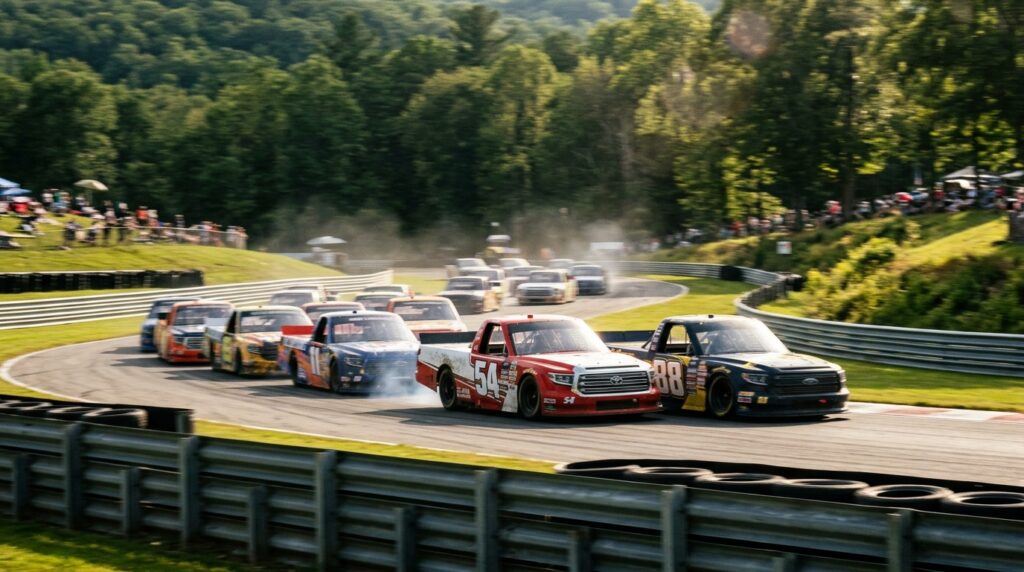
Driving the No. 9 CR7 Motorsports Chevrolet, Enfinger held off Landen Lewis by just 0.483 seconds. The result marked Enfinger’s first NASCAR Truck Series road-course win and the 13th victory of his series career.
For New England truck racing fans, the event provided much more than a memorable national-series result. It demonstrated how discipline, timing, equipment management, and race strategy can determine a winner even when another team appears faster early in the afternoon.
Here is what happened at Lime Rock and why the lessons matter for regional short-track competitors.
Grant Enfinger Lime Rock 2026: How the Race Was Won
The LiUNA 150 took place on Lime Rock Park’s historic Connecticut road course. Unlike the ovals used by many regional truck racing divisions, Lime Rock requires drivers to balance braking, acceleration, direction changes, and racing traffic across several distinct corners.
The 100-lap event produced frequent lead changes and a chaotic final section.
The Final Restart That Changed the Race
For much of the afternoon, Layne Riggs and Kaden Honeycutt appeared to have the trucks to beat.
However, late caution periods and changing strategies reshuffled the running order.
Enfinger’s Pass With Three Laps Remaining
On the decisive restart, Enfinger lined up beside Gio Ruggiero with three laps remaining.
The No. 9 Chevrolet accelerated into the lead when the green flag returned.
Enfinger then had to defend that position against Landen Lewis, who was pursuing his first Truck Series victory.
The pressure was significant because even a small mistake could have changed the finishing order.
Lewis stayed close, but Enfinger managed the final laps and crossed the finish line less than half a second ahead.
The narrow margin illustrated how closely matched trucks can be when a race approaches its conclusion.
However, Enfinger’s win was not simply a matter of having the fastest truck throughout the event.
The veteran later acknowledged that Riggs and Honeycutt had demonstrated stronger pace at earlier stages.
What mattered most was positioning the No. 9 for the final restart and executing when the opportunity arrived.
That distinction is important for drivers competing in local divisions where passing opportunities can be limited.
Why Late-Race Position Can Matter More Than Early Speed
Many races feature competitors who are exceptionally fast during practice or the opening laps.
However, a strong early run does not guarantee a victory.
Drivers must also manage changing track conditions, equipment wear, traffic, and unpredictable cautions.
At Lime Rock, Enfinger’s team remained competitive through a difficult afternoon.
When the final opportunity appeared, the driver and crew were prepared to take advantage.
Local truck racers can apply the same general principle without copying national-series tactics directly.
For example, a driver might benefit from protecting tires during an early stint rather than attempting every available pass.
Another competitor may focus on maintaining clean track position and avoiding unnecessary contact.
However, race rules differ between national and regional organizations.
Teams should always adapt strategy to their division’s procedures, race length, and available equipment.
The official NASCAR Lime Rock race recap provides the confirmed finishing results.
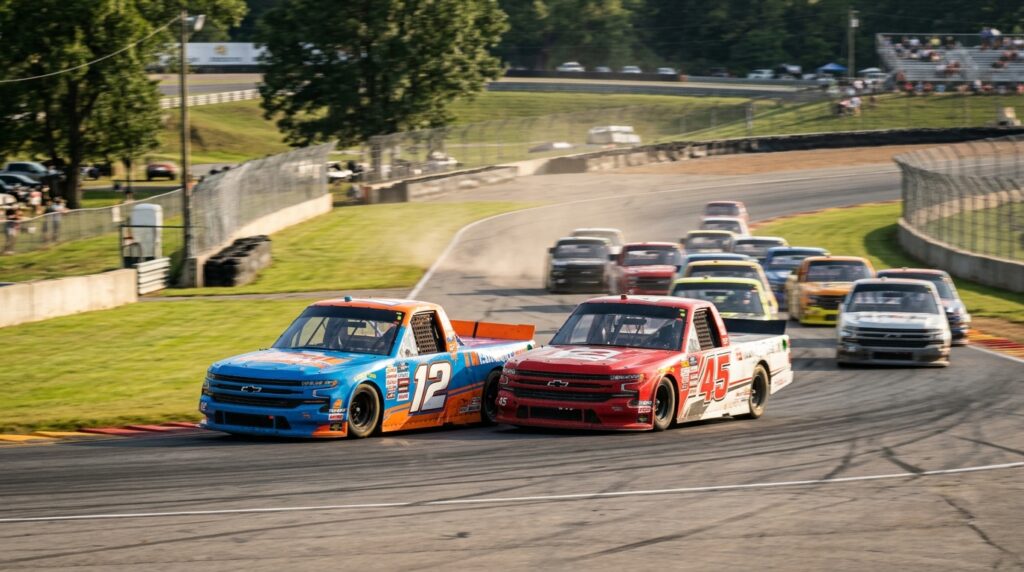
Riggs, Honeycutt, and the Chaos Behind the Winner
Enfinger’s victory was dramatic partly because several championship contenders experienced trouble.
Riggs started on the pole and led the opening 34 laps.
Honeycutt remained competitive and won the second stage.
Race Incidents, Stage Results, and the Final Order
Riggs led a race-high 48 laps and won Stage 1.
However, the closing portion of the race became increasingly difficult.
Multiple cautions interrupted the final 40 laps, and an extended red flag temporarily stopped the action.
Different pit strategies placed some early leaders deeper in the field.
Riggs and Honeycutt also became involved in an incident while working through traffic.
Riggs eventually finished 23rd, while Honeycutt recovered to take third place.
For Honeycutt, that recovery was particularly notable because he had fallen to 24th after a multi-truck accident.
Parker Kligerman finished fourth, followed by Christian Eckes in fifth.
The complete top five showed how the final results could differ substantially from the early running order.
The race also featured a serious-looking incident involving Thomas Annunziata, whose truck caught fire late in the event.
He exited the vehicle and was transported for medical evaluation.
That incident reinforced the importance of functioning safety equipment and properly trained emergency personnel.
Motorsports excitement should never obscure the risks faced by drivers and track workers.
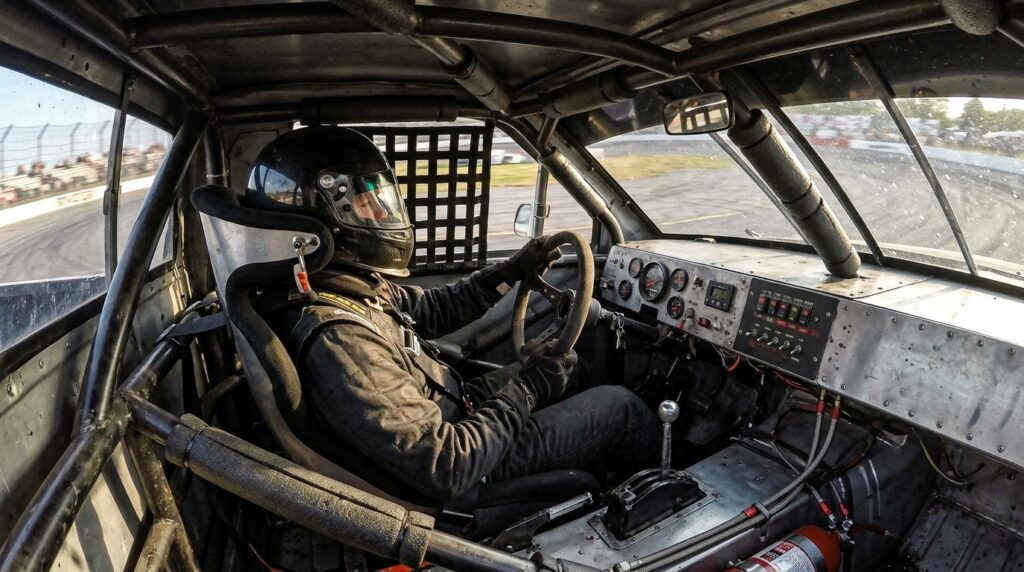
What Lime Rock Teaches New England Short-Track Truck Racers
Many New England regional truck races occur on shorter oval tracks, including New London-Waterford Speedbowl.
Lime Rock’s road-course configuration requires different techniques, but several racing principles remain relevant.
Racecraft, Equipment Management, and Regional Competition
Enfinger’s victory provides a useful case study in preparation and decision-making.
It also demonstrates why a driver should remain focused even when the race appears to favor another competitor.
Control corner entry without sacrificing the exit.
Road-course racing places substantial emphasis on braking before the corner and accelerating smoothly afterward.
A driver who enters too aggressively may lose position when the vehicle runs wide.
On a short oval, corner entry and exit are also important, although the setup and racing lines differ.
Local drivers should focus on repeatable technique instead of attempting a risky move every lap.
Consistent exits can create opportunities without unnecessary contact.
Prepare for restarts before they happen.
Restarts require concentration because the field is compressed and available space becomes limited.
Drivers need to understand the governing rules, maintain awareness, and anticipate nearby competitors.
Enfinger’s final restart showed how one well-executed launch can determine the winner.
However, regional series may use different restart formations and passing restrictions.
Drivers should review their own division’s rulebook rather than assuming NASCAR national-series procedures apply.
Avoid unnecessary equipment damage.
Contact can alter handling, affect tire performance, and turn a competitive truck into one that struggles to finish.
That risk is especially important for smaller teams operating with limited budgets.
Protecting equipment may improve the chances of returning for the next event.
However, cautious driving does not mean avoiding legitimate competition.
It means choosing passes carefully and respecting the racing space available.
Why the Connecticut race matters to local fans
Lime Rock’s national NASCAR event puts New England motorsports in the spotlight.
Fans who normally attend local oval races can compare regional competition with national-level racing.
Both offer examples of teamwork, preparation, and skill.
However, the budgets, technical rules, and logistics are very different.
Drivers should draw practical lessons from national racing without assuming its equipment or strategies can be copied directly.
For more regional background, read our Waterford Speedbowl fan guide.
How local teams can study the race
Race recaps and official results help teams understand how a result developed.
Drivers can examine changes in running order, cautions, and final finishing margins.
Video coverage, where legally available, may also illustrate positioning and driving decisions.
However, teams should avoid treating a single race as evidence that one strategy always works.
Track configuration, weather, regulations, and competing vehicles can change the outcome.
The useful lesson is to prepare multiple options and remain adaptable.
What does the result say about experience?
Enfinger’s win was the 13th of his NASCAR Truck Series career.
Experience can help drivers recognize changing race conditions and manage pressure.
However, younger racers can also succeed through disciplined preparation, good communication, and sound judgment.
Local teams should encourage drivers to review both successful races and disappointing results.
Learning from mistakes can be as valuable as celebrating a podium finish.
Frequently asked questions
Who won the 2026 NASCAR Truck race at Lime Rock?
Grant Enfinger won the LiUNA 150 on July 11, 2026.
What was the winning margin?
Enfinger finished 0.483 seconds ahead of Landen Lewis.
Who finished third?
Kaden Honeycutt recovered from a late incident to claim third place.
Was this Enfinger’s first road-course victory?
Yes. It was his first NASCAR Craftsman Truck Series road-course win.
How many laps were scheduled?
The race was scheduled for 100 laps around Lime Rock Park.
Final thoughts
Grant Enfinger’s Lime Rock 2026 win demonstrated the value of remaining competitive, managing changing conditions, and delivering a decisive restart.
For New England truck racers, the race offers lessons that extend beyond road-course competition.
Reliable preparation, careful equipment management, and smart decisions can matter as much as outright speed.
For more local and national truck racing stories, explore New England Truck Series news.
Editor’s note: This recap is based on NASCAR’s official July 11, 2026 race report and published results.