
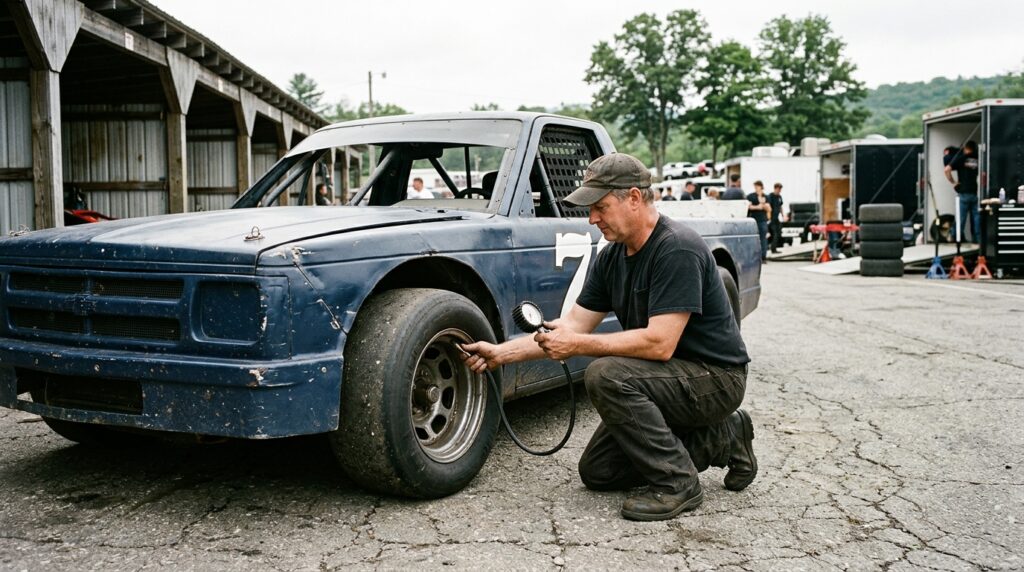
Short-track racing tire management plays an important role in how a truck handles from the opening laps to the checkered flag. At New London-Waterford Speedbowl, drivers need dependable traction while accelerating out of tight corners, braking for traffic, and defending positions.
Tires provide the contact between the truck and the racing surface. Their condition can influence cornering balance, braking behavior, and consistency during a feature race.
However, managing tires requires more than selecting a pressure or choosing a particular brand.
Teams must understand the rules, inspect their equipment, observe wear patterns, and evaluate how driving technique affects performance.
This guide explains the fundamentals of racing tire management, common handling concerns, and a practical approach to evaluating tire performance before the 2027 New England racing season.
Why Tire Management Matters in Short-Track Truck Racing
Short-track racing places repeated loads on the tires as a truck accelerates, brakes, and turns.
Each lap creates heat and mechanical stress.
As the race continues, changing tire conditions can affect how the truck responds to steering and throttle inputs.
Drivers may notice that a truck becomes tighter or looser through the corners.
However, these handling changes can have several causes, so teams should evaluate the complete vehicle before assuming that tire pressure alone explains the problem.
Understand tire grip and racing surface conditions
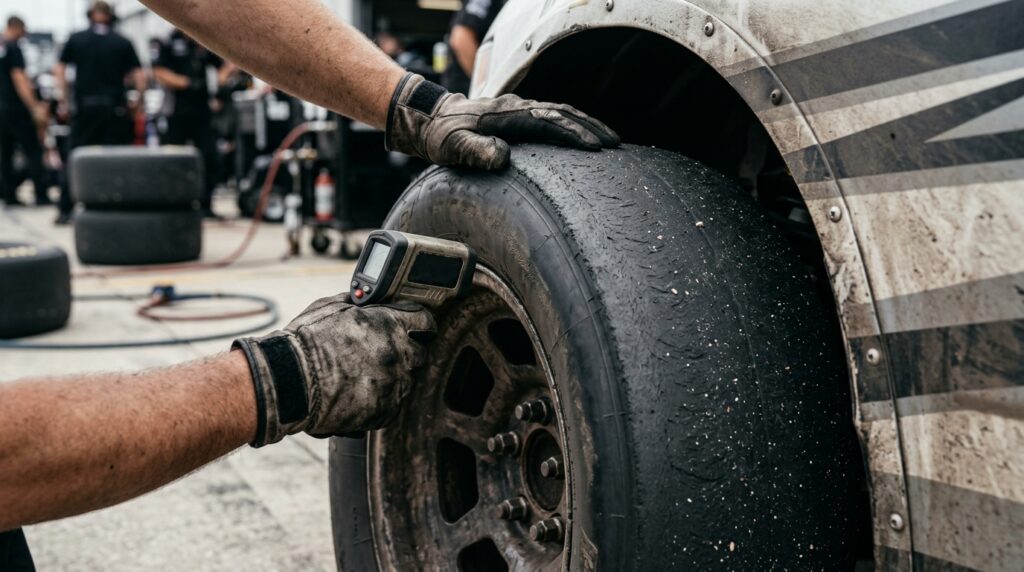
A tire generates grip through its interaction with the racing surface.
Track temperature, pavement characteristics, tire compound, inflation pressure, and driving inputs all influence that interaction.
On an asphalt short track, teams must consider how the tires perform through repeated cornering loads.
The same setup may behave differently during a cool practice session and a warmer feature race.
How tire temperatures affect handling
Tires heat up as the truck moves around the track.
Changes in temperature can alter operating pressure and handling characteristics.
However, hotter is not automatically better, and a single temperature reading rarely tells the entire story.
Teams need to understand the tire manufacturer’s specifications and approved operating conditions.
They should also account for how quickly temperatures change after a truck returns to the pits.
Meaningful comparisons require consistent measurement procedures.
Why tire wear patterns deserve attention
Uneven wear may indicate a problem involving alignment, suspension setup, inflation, driving technique, or another factor.
However, wear patterns should not be interpreted in isolation.
A truck may show unusual wear after contact or an unexpected mechanical issue.
Inspect tires for visible damage, abnormal wear, and other concerns before every approved session.
Replace tires that fail the applicable safety requirements.
Learn how tire choice connects with the rulebook
Local racing divisions may specify approved tire models, compounds, sizes, and preparation restrictions.
Teams must follow those rules rather than assuming that any racing tire is acceptable.
A tire that provides strong performance in one series may not be legal in another division.
Rules may also address tire treatment, purchasing procedures, or inspections.
Always obtain the current official technical regulations before purchasing equipment.
Why legal compliance comes before setup experimentation
Technical rules promote consistency and define the equipment allowed in competition.
Changing tire specifications outside those limits can lead to disqualification or other penalties.
Before testing a modification, verify that it complies with the applicable regulations.
Ask officials for clarification when the wording is uncertain.
Keep records of approved tires and purchase information where the series requires them.
A legal, reliable setup provides a stronger foundation than a potentially faster but noncompliant approach.
How to Improve Tire Management for the 2027 Season
Teams can evaluate tire performance through careful observation and consistent documentation.
However, they should avoid changing several unrelated setup variables at the same time.
When multiple adjustments occur together, it becomes difficult to identify which change influenced the truck.
A structured testing approach helps drivers and crews learn more from their available practice time.
Build a consistent tire inspection and setup routine
Begin every event by confirming that the selected tires comply with current rules and remain suitable for competition.
Inspect the visible tread and sidewalls, check mounting condition, and review the relevant operating specifications.
Record the tire set used during each session.
Also, ask the driver to describe the truck’s handling at corner entry, through the center, and during corner exit.
What to record after practice and qualifying
Keep a simple log showing the session, track conditions, tire identification, approved pressure measurements, and driver feedback.
If the team uses suitable measurement equipment, record tire temperatures consistently.
Note whether the truck developed a push, loose condition, or other handling change during the run.
Include any relevant mechanical adjustments.
These records help teams compare observations without relying entirely on memory.
Understand tight and loose handling conditions
Drivers commonly describe a truck as tight when it resists turning as much as expected.
A loose condition generally describes the rear of the truck losing more stability than the driver wants.
However, those descriptions do not automatically identify the cause.
Tires, suspension geometry, track conditions, and driving technique can all contribute.
Teams should investigate systematically instead of making an immediate, unverified adjustment.
Use consistent tire pressure procedures
Inflation pressure affects tire behavior, but appropriate settings depend on the tire, vehicle, rules, and operating conditions.
Do not copy pressure numbers from another team without understanding the differences.
Use calibrated equipment and follow the correct measurement procedure.
Record whether readings were taken before or after a session.
Make changes only within the applicable specifications and with suitable technical guidance.
Examine the influence of driving style
Tires respond to how a driver steers, brakes, and accelerates.
Abrupt movements may produce unnecessary sliding and heat.
Smoother inputs can help a driver maintain consistency, although the ideal technique varies by vehicle and track conditions.
Drivers should evaluate whether handling problems appear only during particular maneuvers.
Video review and qualified coaching may help identify patterns.
Review long-run performance
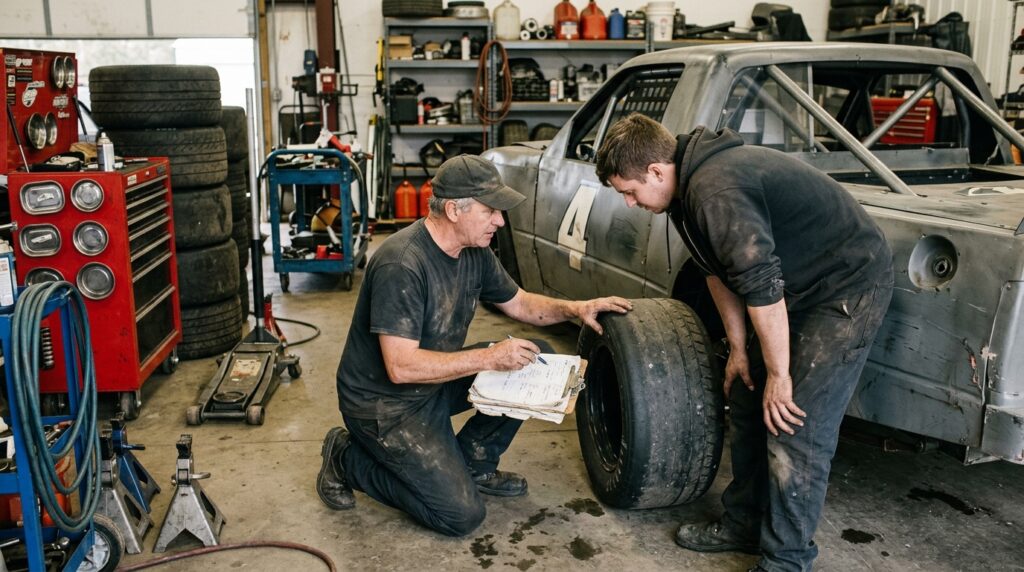
A truck that feels excellent on one qualifying lap may behave differently after an extended run.
Teams should evaluate both immediate pace and consistency.
Ask whether lap times change gradually or suddenly.
Compare those observations with driver feedback and tire measurements.
Do not assume that the fastest opening lap guarantees the best feature-race setup.
Prepare for changing track temperatures
New England race days may begin with warm afternoon practice and continue into cooler evening conditions.
These changes can influence the racing surface and vehicle balance.
Teams should record the conditions rather than relying on assumptions.
When permitted, use earlier sessions to understand how the truck responds.
Develop contingency plans within the official adjustment rules.
Check alignment and suspension condition
Tire behavior depends partly on the mechanical condition of the truck.
Inspect suspension components and alignment using the appropriate technical procedures.
Look for signs of damage or abnormal movement.
Do not assume that a tire problem can be solved by changing pressure when the underlying issue involves a damaged component.
Arrange qualified inspection for safety-critical concerns.
Learn from Waterford’s 2026 season
The 2026 Waterford Truck championship demonstrated the importance of consistency over an entire season.
Ryan Lineham claimed the championship, while Tyler Chapman finished the season with a feature victory during Finale Weekend.
Those results offer an opportunity to discuss the broader value of race preparation.
However, published results alone do not establish which tire setups the teams used.
Read the 2026 Waterford championship report for the verified race outcome.
Avoid unnecessary tire-related expenses
Short-track racing budgets can become difficult to manage when teams replace equipment without clear priorities.
Track tire use and inspect each set carefully.
Follow the applicable rules governing reuse and replacement.
However, never continue using a tire that fails safety requirements merely to save money.
A reliable record can help the team plan legitimate purchases for the season.
Keep measurement equipment reliable
Pressure gauges and temperature measurement devices need appropriate care.
Inspect their condition and follow manufacturer calibration recommendations.
Store equipment securely and protect it from damage.
If different crew members collect measurements, establish a consistent procedure.
Reliable tools support better comparisons across sessions.
Review the data with the driver
Numbers alone do not explain every handling change.
Drivers provide important information about how the truck feels under braking and through corners.
Combine that feedback with measurements and inspection results.
Ask questions without assuming the driver or crew made a mistake.
A collaborative review often produces better decisions than arguing over one reading.
Prepare a preseason tire management checklist
Before the first 2027 race, review the official rulebook and approved tire specifications.
Inspect the truck’s wheels and suspension, confirm that measurement equipment works correctly, and prepare a consistent recordkeeping system.
Plan how the team will collect feedback during authorized practice sessions.
Ensure that crew members understand their responsibilities.
Keep safety and legal compliance ahead of experimental setup changes.
Continue learning from reliable sources
Manufacturer instructions, racing officials, and qualified motorsport technicians provide valuable technical guidance.
For general information about tire maintenance, consult the U.S. Tire Manufacturers Association’s tire care and safety resources.
However, ordinary road tire recommendations do not replace racing tire specifications or series regulations.
For more New England motorsport coverage, visit our truck racing articles archive.
Why tire management matters beyond a single race
A successful racing program builds knowledge throughout the season.
Each practice session, qualifying run, and feature can provide information about tire behavior.
Teams that preserve those observations may become better prepared for similar conditions later.
However, racing surfaces, weather, and mechanical setups continue changing.
No collection of notes can replace current inspections and sound judgment.
Short-track racing tire management involves more than chasing maximum grip for one lap.
By understanding tire behavior, following technical rules, and developing reliable inspection routines, New England truck racing teams can approach the 2027 season with greater consistency.
Technical disclaimer: This guide provides general motorsport education. It does not prescribe tire pressures, suspension settings, or vehicle modifications. Follow the applicable race-series regulations and manufacturer’s specifications.