
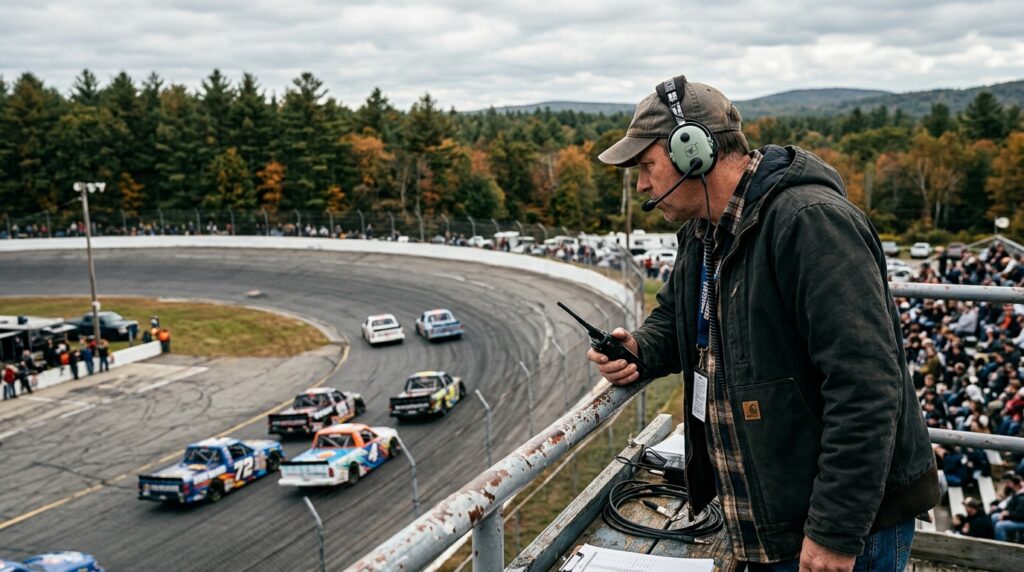
Short-track racing spotter communication can make a major difference when truck drivers compete in tight traffic. At New England oval tracks, drivers often have limited room to pass, little time to react, and several competitors fighting for the same racing line.
A spotter helps a driver understand what happens outside the windshield. Through approved radio communication, the spotter can identify nearby vehicles, changing track conditions, and instructions from race officials.
However, effective spotting involves more than speaking frequently. The information must be accurate, concise, and easy for the driver to understand.
This guide explains the spotter’s responsibilities, useful communication habits, restart preparation, and ways New England racing teams can build a more coordinated operation for the 2027 season.
What Does a Spotter Do in Short-Track Truck Racing?
A racing spotter acts as an additional set of eyes for the driver.
The position may offer a clearer view of surrounding traffic than the cockpit provides.
However, spotters must follow the specific communication and location rules established by the track or racing division.
Not every local series uses the same spotter arrangements. Some allow extensive radio guidance, while others impose additional limits.
Understand the spotter’s role before race night
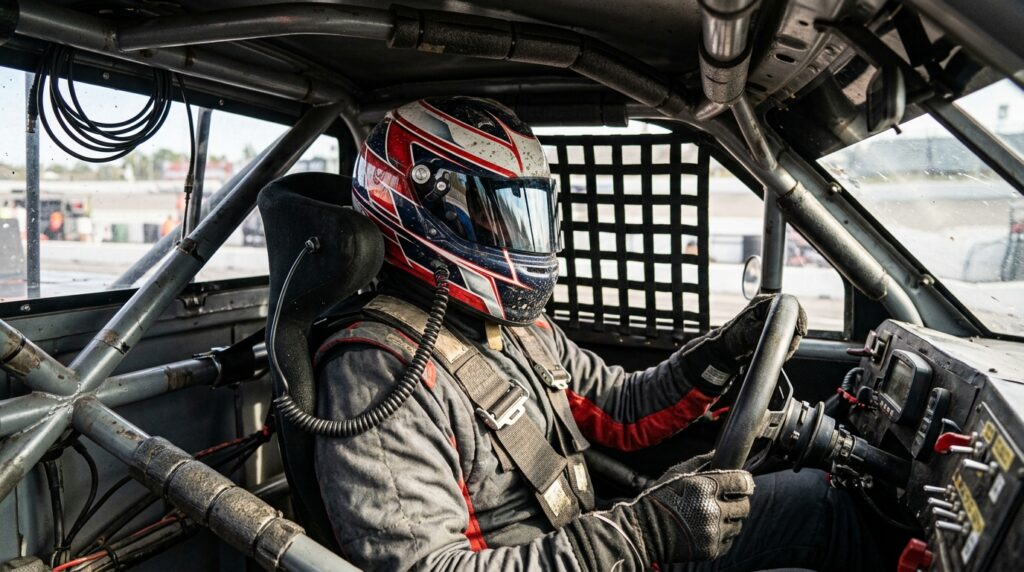
Drivers and spotters should agree on responsibilities before the first practice session.
The spotter must understand which information the driver considers most useful.
For example, a driver may want immediate warnings about cars alongside, but prefer minimal conversation during ordinary green-flag laps.
A clear arrangement prevents unnecessary radio traffic when the driver needs maximum concentration.
Why clear and brief radio messages matter
Race drivers process information quickly while managing steering, braking, throttle inputs, and nearby competitors.
Long explanations may distract them during a critical moment.
Short, familiar instructions generally provide more useful information.
A spotter might use predetermined calls indicating a vehicle alongside, a cleared position, or an approaching caution.
However, teams should establish the exact wording together rather than copying unfamiliar terminology without discussion.
Consistency helps the driver recognize important instructions immediately.
How spotters help drivers manage nearby traffic
A driver may struggle to see a competitor positioned near the rear quarter of the truck.
The spotter can provide information about that vehicle’s location when visibility allows.
However, a spotter should never announce that a lane is clear unless the observation supports that call.
An inaccurate instruction may contribute to avoidable contact.
Drivers also retain responsibility for controlling their trucks and following racing rules.
Our beginner’s guide to truck racing in New England explains why communication and awareness matter for new competitors.
Develop a consistent communication system
Successful teams often use predictable radio language.
The goal is to reduce confusion, especially when a race becomes intense.
A spotter and driver should review common scenarios before entering the track.
These discussions can cover passing attempts, restarts, caution periods, and mechanical concerns.
Build a simple vocabulary for race situations
Start with a few important categories: nearby traffic, clear space, cautions, track hazards, and instructions from officials.
Agree on which phrases describe each situation.
For example, one phrase might indicate that a competitor remains alongside, while another confirms the lane has cleared.
Keep those phrases distinct.
Avoid using similar words for different situations when noise or radio interference could create confusion.
During practice, confirm that every driver understands the system.
How to Improve Spotter and Driver Teamwork for 2027
Radio communication improves when teams practice consistently.
A driver who trusts the spotter can focus more effectively on vehicle control.
Meanwhile, a spotter who understands the driver’s habits can provide information at useful moments.
However, trust must come from accuracy and preparation rather than blind confidence.
Practice communication before competitive racing
Where the rules permit spotting, approved practice sessions provide an opportunity to evaluate radio performance.
Teams can test equipment, confirm terminology, and review communication timing.
They should also discuss how to respond if the radio stops working.
Never wait until a championship race to discover that the driver cannot hear essential instructions.
Prepare for starts, restarts, and caution periods
Restarts often concentrate several trucks within a small area.
Drivers need to understand the restart procedure and maintain awareness of surrounding competitors.
Spotters can communicate relevant information while avoiding unnecessary predictions about what another driver may do.
During cautions, teams may have more time to discuss the truck’s handling and upcoming priorities.
However, official race-control instructions always take precedence.
Check radio equipment before leaving the pits
Test the driver’s headset, microphone, receiver, and power supply.
Confirm that the spotter can hear the driver clearly and that both parties use approved frequencies or communication equipment.
Secure cables and connections according to the equipment manufacturer’s instructions.
Keep spare batteries or approved backup components when practical.
Electrical problems can interrupt communication even when the rest of the truck performs well.
Choose an authorized spotting location
A spotter needs a clear view of the racing surface, but access rules differ by venue.
Use only authorized viewing locations.
Do not climb fences, enter restricted structures, or position equipment where it could interfere with officials.
If the designated location has limited visibility, discuss those limits with the driver beforehand.
Spotters must communicate what they can verify rather than guessing about unseen areas.
Understand the importance of calm communication
Racing can become emotional when drivers experience contact or lose positions.
However, shouting unrelated comments over the radio may make the situation worse.
A spotter should communicate important observations clearly and avoid escalating disputes.
Likewise, drivers should provide useful feedback without overwhelming the radio channel.
After the race, the team can review disagreements more calmly.
Use practice sessions to build confidence
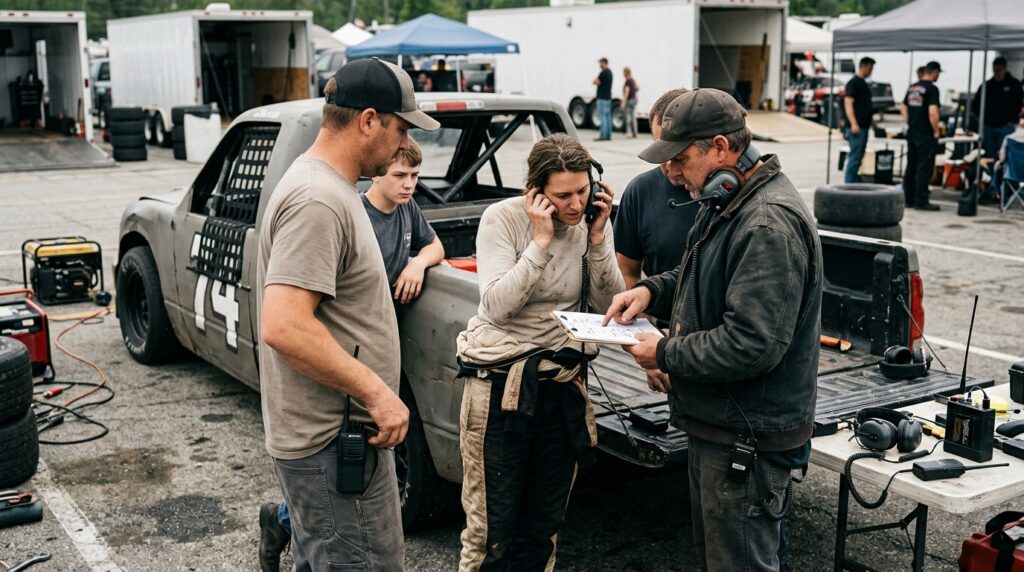
A new driver and spotter partnership may require several sessions before their timing becomes natural.
Begin by practicing basic traffic calls when permitted.
Then review whether instructions arrive too early, too late, or at appropriate moments.
Ask the driver which messages were useful and which caused distraction.
Modify the communication plan based on that feedback.
Learn from racing footage after the event
Where recordings and series rules allow, teams can compare available race footage with radio communication.
Look at situations where the driver gained positions or encountered traffic.
Determine whether the spotter accurately described nearby vehicles.
Avoid evaluating a decision only through hindsight.
The spotter and driver did not necessarily have the same information available that viewers can see in a replay.
Our 2026 Waterford Truck championship recap illustrates the importance of passing decisions and race management.
Coordinate the spotter with the crew chief
Some teams use separate spotter and crew-chief roles. Others have fewer personnel.
Whatever the arrangement, establish who communicates specific information.
For example, the crew chief may focus on mechanical concerns and setup, while the spotter concentrates on traffic.
Clear role assignments reduce the chance of several people talking simultaneously.
Every arrangement must comply with the applicable competition rules.
Develop a response to radio failure
Radio equipment can fail because of depleted batteries, damaged connections, or interference.
Teams should discuss a contingency plan before competition.
Drivers must continue following official flags, track signals, and race procedures.
If communication failure creates a serious safety concern, the team should follow the applicable rules for withdrawing or seeking assistance.
Do not improvise unsafe signals during live competition.
Keep track of common communication mistakes
Some teams give too much information during ordinary racing conditions.
Others use inconsistent instructions or fail to confirm whether the driver heard a message.
Another mistake involves announcing that a competitor is clear too early.
Spotters should recognize these patterns through structured reviews.
Improving a few recurring weaknesses can be more useful than developing an unnecessarily complicated radio system.
Understand that the driver makes the final decision
Spotters provide information, but they do not physically control the truck.
A driver’s immediate view and vehicle response remain important.
If a spotter suggests a position is available, the driver must still respond to actual conditions.
Neither party should assume that radio instructions guarantee safety.
The goal is better shared awareness, not transferring responsibility away from the driver.
Learn from professional racing communication
National-level NASCAR teams rely on structured communication among drivers, spotters, and crew members.
Local teams can study the general principles of clear instructions and disciplined teamwork.
However, professional systems may include resources unavailable to smaller operations.
Adapt the useful ideas rather than trying to imitate every detail.
The official NASCAR website provides racing coverage and educational context.
Prepare a 2027 communication checklist
Before the next season, confirm the series’ current spotter rules and equipment requirements.
Review the driver’s preferred terminology and agree on the most important instructions.
Test the radio system and arrange authorized practice when available.
Discuss the procedure for cautions, restarts, and equipment failure.
Keep written notes from practice and race reviews.
Why communication matters in New England racing
New England short-track racing combines close competition with a strong grassroots team culture.
Effective communication helps drivers interpret traffic and supports more organized decisions.
It also encourages teamwork between the people inside and outside the truck.
For drivers who want to develop their skills, communication deserves attention alongside vehicle setup and driving technique.
Short-track racing spotter communication is ultimately about accuracy, trust, and preparation.
Teams that establish consistent terminology, practice appropriately, and review performance can build a more effective racing operation for 2027.
Safety disclaimer: Spotter rules and communication requirements differ by series and venue. Follow official racing instructions and seek qualified motorsport training.