
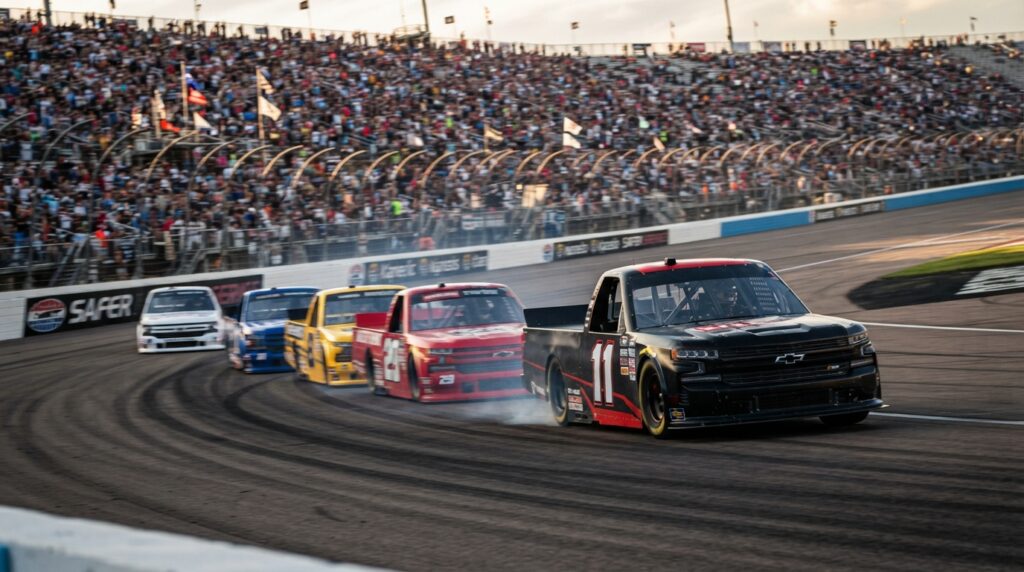
The 2026 NASCAR Craftsman Truck Series championship battle changed dramatically at Kansas Speedway. Kaden Honeycutt entered the second race of the Chase as one of the strongest title contenders, but he left Kansas with something even more important: the championship lead.
Honeycutt delivered one of the most complete performances of the Truck Series season on September 26. Driving the No. 11 TRICON Garage Toyota, he swept all three stages, led 111 of the race’s 134 laps, and won the Race to Stop Suicide 200. The victory was his third of the season and moved him ahead of Layne Riggs in the championship standings with five Chase races remaining.
For New England truck racing fans, the development is especially interesting because the championship story has strong connections to the region. Riggs won the regular-season finale at New Hampshire Motor Speedway in August, while Honeycutt’s crew chief, Scott Zipadelli, is a Connecticut native with deep roots in Northeast racing.
The result at Kansas therefore does more than change a national points table. It creates another example of how regional racing experience, race execution, consistency, and crew leadership can influence the biggest stages in truck racing.
How Kansas Changed the 2026 NASCAR Truck Series Chase
The 2026 Truck Series Chase began with Layne Riggs carrying significant momentum. He entered the postseason as the No. 1 seed after winning six races during the regular season, including the dramatic double-overtime finale at New Hampshire Motor Speedway.
That New Hampshire performance looked like the perfect way to begin a title run. Riggs led 106 laps at Loudon and survived two overtime restarts to defeat teammate Chandler Smith. You can revisit that race in our breakdown of Layne Riggs’ double-overtime New Hampshire victory.
However, postseason racing can erase a regular-season advantage quickly. After difficult results at Bristol and Kansas, Riggs suddenly found himself chasing Honeycutt rather than protecting the points lead.
Honeycutt Delivered a Near-Perfect Kansas Performance
Kansas was not simply a race Honeycutt happened to win. The No. 11 team controlled almost the entire event.
Honeycutt won the first stage, won the second stage, and eventually completed the stage sweep by taking the checkered flag. NASCAR reported that he led 111 of the 134 laps. That level of control matters because championship racing rewards more than the final finishing position. Stage results create additional opportunities to collect points, while leading the race gives a team control over strategy and track position.
The victory also reinforced the consistency Honeycutt had shown before the Chase. He entered the postseason as the No. 2 seed after a regular season that included wins at Watkins Glen and Richmond and a strong run at New Hampshire.
Sweeping All Three Stages Maximized the Championship Opportunity
In a short postseason, maximizing points matters. A driver who finishes well but gives away stage points can still lose ground to a rival who performs near the front throughout the entire race.
Honeycutt avoided that problem at Kansas. By controlling the stages as well as the finish, he converted his speed into the maximum type of race-day result a championship team wants.
That lesson applies at every level of motorsports. Local racers often focus on the trophy, but championships are normally built through repeatable execution. Qualifying, heat races, feature finishes, avoiding penalties, and keeping the truck mechanically sound can all contribute to the season-long picture.
The Long Rain Delay Added Another Test for the No. 11 Team
The race was interrupted by a lengthy weather delay after Lap 69. Drivers and teams had to wait for conditions to improve before returning to competition.
Long stoppages can disrupt rhythm. Tires cool, track conditions can change, and drivers must mentally reset before climbing back into a race that was already underway.
Honeycutt and the No. 11 team responded by maintaining control after the restart. That may not appear as dramatic as a last-lap pass, but championship teams often separate themselves through exactly that type of execution. They adapt when circumstances change and avoid turning an unusual situation into a bad result.
Layne Riggs’ Kansas Setback Shows How Quickly the Chase Can Turn
Riggs entered Kansas trying to recover from a difficult Chase opener at Bristol. His afternoon showed promising signs, but late-race trouble changed the result.
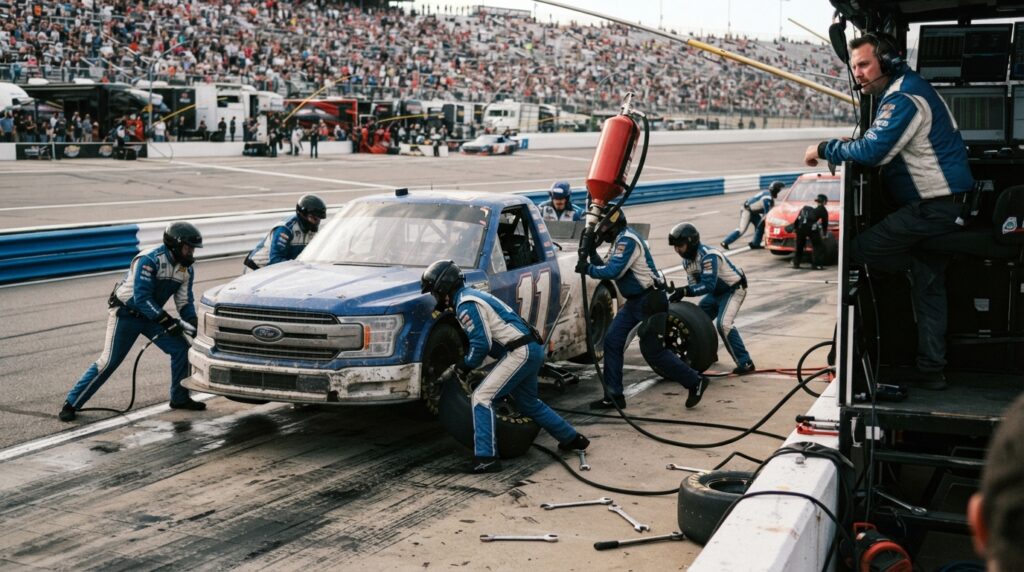
According to NASCAR, Riggs encountered multiple problems during the event. A slow pit stop involving loose lug nuts on the left-front wheel dropped him back in the running order. He managed to work his way forward after the rain delay, but contact with the wall late in the race contributed to a 19th-place finish.
The contrast with Honeycutt was significant. One championship contender collected nearly everything available, while the other left valuable points on the table.
A 37-Point Deficit Changes the Strategy but Does Not End the Fight
Riggs left Kansas 37 points behind Honeycutt with five Chase races still remaining. That is a meaningful gap, but the Kansas race itself shows why championship standings can move quickly.
A mechanical problem, pit-road mistake, crash, tire issue, or poorly timed caution can change a driver’s position in a single afternoon. The challenge for Riggs is to stop the difficult results before the deficit becomes harder to overcome.
New England fans have already seen what the No. 34 team can do when everything comes together. At New Hampshire, Riggs controlled the closing portion of the race and handled repeated overtime pressure. The question now is whether that type of performance can return during the final stretch of the Chase.
Our earlier look at the road from Richmond to New Hampshire showed how quickly points and strategy can alter a championship picture even before the postseason begins. Kansas provided another example.
Why Honeycutt’s Championship Run Matters to New England Truck Racing
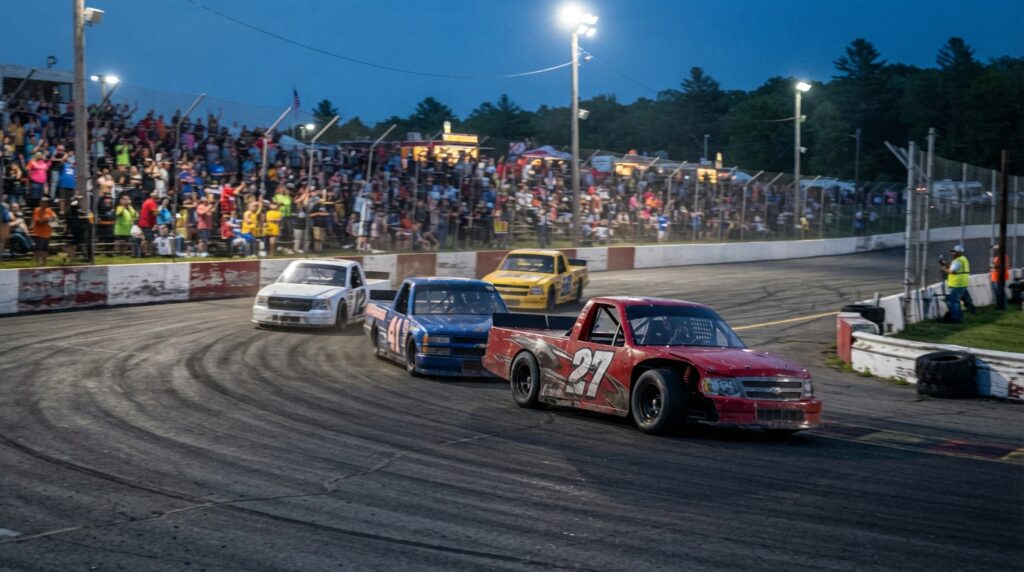
The connection between Honeycutt and New England goes deeper than one race at New Hampshire. His crew chief, Scott Zipadelli, grew up in Connecticut and represents the kind of racing pathway that has long connected Northeast short tracks with NASCAR’s national divisions.
Zipadelli returned to Connecticut earlier in 2026 when the Truck Series raced at Lime Rock Park. Honeycutt finished third there in the No. 11 TRICON Garage Toyota, providing another visible link between a national championship contender and New England motorsports.
Our profile of Scott Zipadelli’s path from Connecticut short tracks to NASCAR explains why crew members are just as important to the region’s racing pipeline as drivers.
National Championship Racing Offers Lessons for Local Teams
Honeycutt’s Kansas performance demonstrates several ideas that regional racers can recognize immediately. Speed matters, but speed alone does not create a championship.
A race team has to prepare the truck correctly, communicate during practice, adjust to changing conditions, execute pit work, manage restarts, and avoid unnecessary mistakes. The driver then has to convert that preparation into consistent laps while making good decisions in traffic.
Those principles are visible every weekend at regional short tracks. The budgets and technology may be different, but the basic process remains familiar.
Consistency, Crew Communication, and Adaptability Translate to Short Tracks
A strong local racing program is rarely built around one fast night. Teams that regularly compete for championships usually develop repeatable habits. They arrive prepared. They keep accurate setup notes. They understand how their truck changes during a race. They solve problems without panicking, and they finish difficult nights instead of turning them into unnecessary DNFs.
That is one reason following national Truck Series racing can be useful for regional drivers and crews. The television product may highlight victories and dramatic passes, but underneath those moments is a system of preparation and decision-making that grassroots teams understand well.
National momentum can also help regional truck racing attract new fans. Someone who discovers Honeycutt, Riggs, or another Truck Series contender may start looking for similar racing closer to home. That creates an opportunity for tracks and regional divisions throughout New England.
Our article on how the 2026 truck racing boom can grow New England short-track racing explores how national attention, manufacturer involvement, streaming, and stronger storytelling can help local racing reach a wider audience.
The championship is far from finished. Honeycutt has taken control after Kansas, but five races remain and every contender still faces the same risks that changed the standings during the first two Chase events.
Riggs has already demonstrated race-winning speed. Chandler Smith remains another experienced threat. Other Chase drivers have opportunities to close the gap if the leaders encounter trouble. In NASCAR postseason racing, one bad weekend can erase weeks of progress.
For New England fans, that uncertainty makes the rest of the 2026 Truck Series Chase worth following. The championship started with a statement victory by Riggs at New Hampshire, but the momentum now belongs to Honeycutt and a No. 11 team led by a Connecticut-born crew chief.
Kansas showed what a championship performance looks like: speed from the start, stage points, adaptability through a major weather delay, and execution when the race resumed. Whether Honeycutt can maintain that level through the remaining races will determine how the 2026 season is remembered.
For official race results and continuing championship coverage, visit NASCAR’s official Kansas Truck Series race recap.
The next chapter will come quickly. For fans of New England truck racing, it is another reminder that the skills developed on short tracks—consistency, preparation, patience, adaptability, and teamwork—remain just as important when a national championship is on the line.