
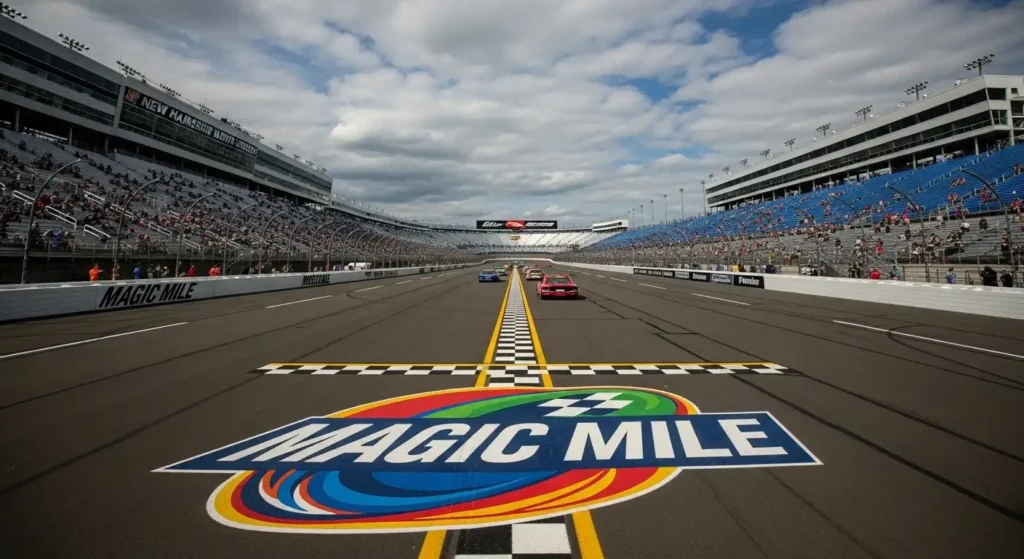
In the high-octane world of the NASCAR Craftsman Truck Series, every lap matters, but some laps carry the weight of an entire season. For 2026, that weight falls squarely on the shoulders of the “Magic Mile.” In a strategic calendar shift that has New England racing fans buzzing, the Team EJP 175 at New Hampshire Motor Speedway (NHMS) has been designated as the official regular-season finale. On August 22, the 1.058-mile oval in Loudon will transform from a technical challenge into a playoff battlefield.
The Stakes: Why a New Hampshire Finale Changes Everything
Traditionally, regular-season finales are held at high-speed intermediate tracks or superspeedways where “The Big One” can dictate the playoff field by sheer luck. By moving the cutoff to New Hampshire, NASCAR has signaled a return to “driver-first” competition. NHMS is a notoriously difficult track that rewards precision, patience, and a deep understanding of mechanical grip.
For the drivers sitting on the “playoff bubble,” there is no place to hide at the Magic Mile. You cannot simply stay in line and draft your way into the post-season. To secure a spot in the 2026 playoffs, a driver must master the flat, sweeping corners of Loudon, where the difference between a top-five finish and a day-ending wall-scrape is measured in millimeters.
Decoding the “Magic Mile”: A Technical Deep Dive
To understand why this race will be so chaotic, one must understand the track itself. New Hampshire Motor Speedway is often compared to a giant version of a local short track, but with the speeds of a superspeedway. The corners are incredibly flat, with only 2 to 7 degrees of variable banking. This lack of banking means the trucks rely almost entirely on “mechanical grip”—the physical connection between the tires and the asphalt—rather than aerodynamic downforce pushing them into the track.
As we saw in our previous coverage of the 2026 technical updates and the return of Ram, the current generation of trucks is more sensitive to “aero-push” than ever. When a driver gets close to the bumper of the truck in front, the air is taken off their nose, causing the truck to stop turning. At a flat track like NHMS, this “push” is magnified. If you can’t get your truck to rotate in the center of turns 2 and 4, you are essentially a sitting duck on the long straightaways.
The Playoff Bubble: Who is at Risk?

As the series moves through the grueling summer months—including the high-pressure Triple Truck Challenge—the points standings will begin to stratify. However, the “bubble”—usually the positions between 8th and 12th in the standings—remains fluid until the checkered flag waves at Loudon.
Heading into the August 22 finale, we expect several key names to be fighting for their lives. Veteran drivers who have had a string of bad luck will be looking for a “Hail Mary” win, while talented rookies will be trying to point their way in. In the Truck Series, a win at any point in the regular season guarantees a playoff berth. This means a driver sitting 20th in points could theoretically “steal” a spot from a consistent front-runner by pulling off an upset at the Magic Mile.
Strategy: The Crew Chief’s Nightmare
The Team EJP 175 is not just won on the track; it’s won on the pit box. Because track position is so vital at New Hampshire, crew chiefs face a grueling dilemma on every caution flag:
- Stay Out: Gain track position but risk being eaten alive by trucks on fresh rubber.
- Two Tires: A “middle ground” strategy that saves time but can leave the truck unbalanced.
- Four Tires: The safest bet for speed, but dropping to 15th place on a flat track can be a death sentence for a playoff hopeful.
New England’s Home Turf Advantage
One of the most exciting aspects of the 2026 finale is the “home-field” advantage for Northeast drivers. New England has a rich history of modified racing, and the driving style required for a ground-pounding Modified is remarkably similar to what is needed to win in a Truck at Loudon. Drivers who cut their teeth at tracks like Stafford, Thompson, or Riverhead often have a psychological edge at NHMS.
For the fans, this race is more than just a points battle. It is a celebration of the North State community. From the campers at “Tailgate Hill” to the fans filling the grandstands, the energy at a regular-season finale is unmatched. It is the one weekend where the national spotlight of NASCAR shines directly on our backyard, proving that New England remains one of the strongest hubs for motorsports in the country.
Sim Racing: Preparing for the Finale
If you are a fan of sim racing and racing simulators, the New Hampshire finale offers a unique opportunity to engage with the race. Most major sim platforms feature a highly accurate laser-scanned version of NHMS. Practicing the “diamond” line—where you drive deep into the corner, square it off, and launch early onto the straightaway—can give you a much deeper appreciation for the moves the pros will be making on August 22.
What to Watch for on Race Day
As the trucks take the green flag for the Team EJP 175, keep your eyes on two things: the “cut line” graphics on the broadcast and the tire fall-off. As the sun sets over the New Hampshire hills, the track temperature will drop, potentially changing the grip levels mid-race. The teams that can adjust their chassis to handle the transition from day to night will be the ones standing in victory lane.
Conclusion: The Road to the Championship Starts Here
The 2026 NASCAR Craftsman Truck Series has been a season of change—from new manufacturers to high-stakes bonuses. But all of that leads to this: 175 miles at the Magic Mile to decide who gets a shot at the championship trophy. Whether you’re a die-hard Chevy fan, a Toyota loyalist, or part of the new “Ram Revolution,” the New Hampshire finale is the race you cannot afford to miss.
Check back with New England Truck Series throughout August for exclusive driver interviews, “Bubble Watch” updates, and a full breakdown of the post-race inspection results. We’ll see you at the track!